Surveillance
CBP biometric-exit task orders and the DHS privacy assessments that trail them
Customs and Border Protection has used successive task orders to expand facial-comparison exit screening at air and seaports. Department of Homeland Security privacy impact assessments describe the same architecture in slower, more general terms, and the two paper trails do not always move in lockstep.
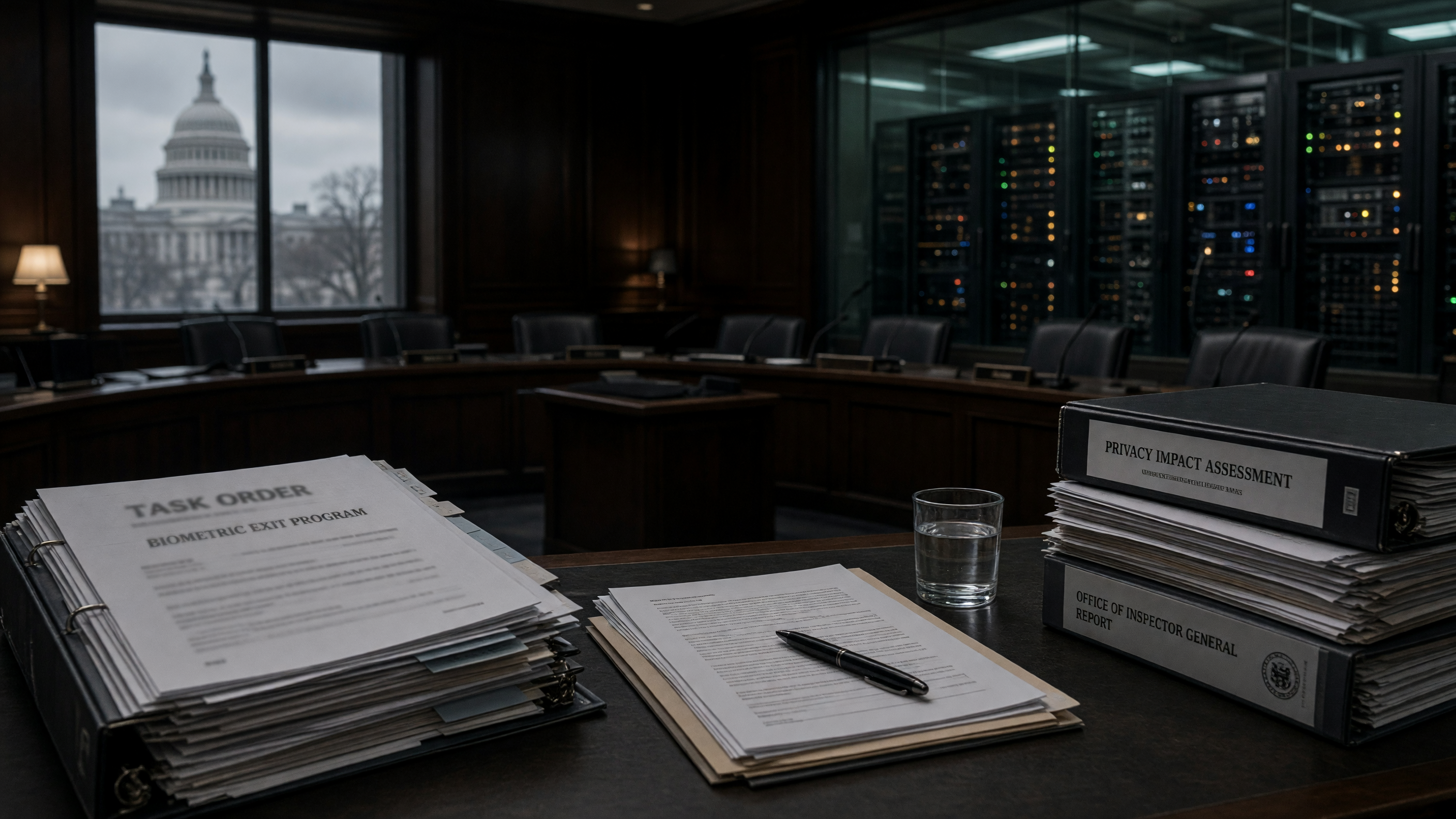
U.S. Customs and Border Protection has, for more than a decade, treated biometric exit as an operational requirement rather than a pilot. Public contracting records and program notices show a pattern of task orders under existing vehicles—often issued to systems integrators already on DHS schedules—to field cameras, matching software, and network links at outbound air gates and, in more limited form, seaports. The stated purpose, according to CBP and DHS program materials, is to confirm that a traveler who entered the country is the same person departing, using a face image compared against a gallery drawn from passport, visa, and other encounter photographs.
Department of Homeland Security privacy impact assessments for related systems—Traveler Verification Service, Automated Targeting System, and successive “biometric exit” PIAs—describe collection, retention, sharing, and redress in the language of the E-Government Act. Those assessments typically lag the operational description found in statements of work. Contracting documents posted on SAM.gov and related award notices have, according to the public record, specified camera placement, throughput, matching thresholds, and integration with CBP’s TECS and arrival-departure information systems before a corresponding PIA update appears on the DHS privacy office site.
The statutory backdrop is not new. Congress directed a biometric entry-exit system in the Illegal Immigration Reform and Immigrant Responsibility Act of 1996 and restated the mandate in later appropriations and authorization bills. GAO has repeatedly reported that a comprehensive land-border biometric exit remains unfinished; air exit has advanced further. CBP officials have said in testimony and fact sheets that facial comparison at departure is the practical path for air travel because it can be done without additional kiosks in every lane. Privacy assessments acknowledge that the comparison is generally one-to-many against a gallery of recent encounters, that a match or no-match result can be retained, and that images may be shared with other DHS components and, under existing agreements, with foreign partners and other U.S. agencies.
Task orders, as they appear in public award data, tend to be narrower and more concrete. They name sites, quantities of cameras, software licenses, and periods of performance. They often sit under indefinite-delivery vehicles awarded to firms that also hold work on entry processing, targeting, and identity management. The public docket does not always show a one-to-one mapping between a given task order’s technical annex and a PIA that names that annex. DHS privacy policy requires PIAs when a system of records or a new collection of personally identifiable information is involved; program offices have argued in published PIAs that incremental camera deployments at additional airports are covered by an existing assessment if the data flows and retention rules are unchanged.
Inspectors general and GAO have noted the gap in language if not always in legal coverage. A DHS Office of Inspector General report on biometric exit implementation described schedule pressure, incomplete testing, and incomplete documentation of how match results feed secondary inspection. GAO work on the same portfolio has described cost growth, incomplete land-exit capability, and the need for clearer metrics on false non-matches. Neither body, in unclassified products, alleged that task orders secretly created a new database; both described a program whose contracting pace outran some of the public privacy paperwork.
Retention is a recurring point of tension in the published PIAs. CBP materials state that images of U.S. citizens collected in the exit process are generally deleted after a short period if the comparison is successful, with longer retention for non-citizens and for cases referred for further inspection. Privacy assessments list exceptions: law-enforcement lookouts, ongoing investigations, and records that become part of an enforcement file. Civil-liberties groups have argued in comments on those PIAs that “short period” is not a bright line and that galleries used for matching may include images from other DHS encounters. CBP has responded in the same comment dockets that galleries are limited by encounter type and recency and that travelers can request records through FOIA and the Privacy Act, subject to exemptions.
The revolving relationship between integrators and the department is visible in award histories rather than in a single scandal. Companies that won entry-side biometric work later appear on exit-side task orders. That pattern is common in federal identity systems and is not, on the public record, unique to CBP. What the record does show is that privacy assessments name categories of contractors as “service providers” with access under DHS rules, while the task orders name the firms, the CLIN structure, and the places of performance. Readers of both sets of documents therefore see two resolutions of the same program: one in dollars and cameras, one in Fair Information Practice Principles.
Land borders remain the unfinished clause. Public budgets continue to fund studies and limited pedestrian or vehicle pilots; full biometric exit for vehicles at the southwest border has not been declared operational in the same way as air. PIAs for those pilots describe different cameras, different galleries, and different legal authorities, including those tied to immigration inspection rather than solely to airline outbound processing. Task orders in that lane, where they appear, are smaller and more experimental. The mismatch between air-exit contracting volume and land-exit PIA detail is a matter of public budget tables, not of a leaked annex.
DHS has published Privacy Threshold Analyses and PIA updates when it judged that a change was material—new sharing, new retention, a new population. Program offices have also determined that adding airports under an existing architecture did not require a new PIA. That determination is recorded in the assessments themselves. Whether it satisfies the spirit of the E-Government Act is a question for oversight hearings; whether it matches the specificity of a task order’s statement of work is a documentary fact. The two genres of paper—procurement and privacy—describe one system at two speeds. The contracting record shows cameras going in. The privacy record shows, after an interval, how the department says those cameras are allowed to remember a face.